Young children notice the world in simple forms. Circles in the sun, squares in HDB windows, triangles in rooftops. From the very first years, shapes are everywhere around them.
Most parents know shapes matter, but are not always sure how to teach shapes to preschoolers, what to teach first, how to explain it in a simple way, or how to keep a three-year-old interested long enough to learn.
You do not need fancy tools or a structured classroom to make it work. Everyday moments at home, simple games, and a little patience go a long way in helping young children recognise and remember shapes in a way that feels natural and fun.
Here’s what you’ll learn, which shapes your K1 or K2 child should start with, fun games and activities that make shapes stick, the best local books and apps to support learning, and what to do if your child needs a little extra time.
What Shapes Are Actually Teaching Your Child
Shapes are one of the first ways young children make sense of the world. Before they can read or count, they are already noticing how things look. A ball is round. A door is tall and straight. A slice of watermelon is a triangle. Their little brains are already busy sorting and comparing.
When children learn to name shapes, they are also building early skills in maths and writing without even knowing it. Recognising a circle helps later with letters like O and C. Spotting a square helps with number recognition. It all connects.
For K1 and K2 children, shape recognition is not about drilling flashcards. It is about helping your child feel curious and capable as they explore the world they already live in every day.
Which Shapes Should Your K1 or K2 Child Learn First?
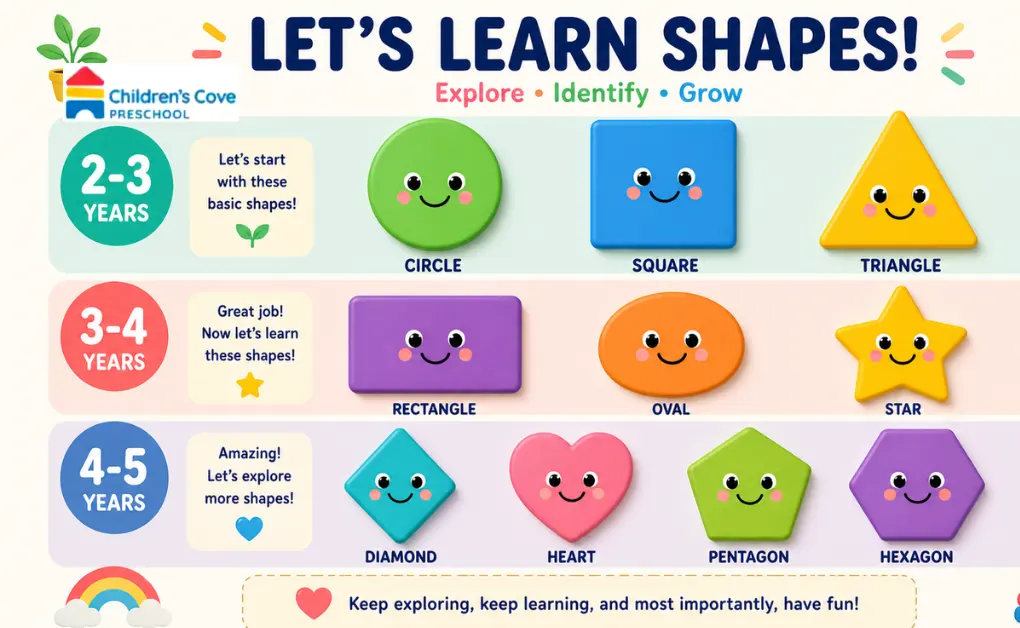
Not all shapes need to be taught at the same time. Starting simple makes a big difference, especially for children who are just beginning to notice the world around them. Here is a rough guide by age so you know what to expect.
1. Ages 2 to 3
At this age, keep it to the basics. Three shapes are plenty to start with.
- Circle
- Square
- Triangle
These show up everywhere in daily life and are easy for little hands to trace and draw.
2. Ages 3 to 4
Once your child knows the first three well, you can slowly add more.
- Rectangle
- Oval
- Star
Keep it fun and low pressure. There is no rush to move on until they feel sure.
3. Ages 4 to 5 (K1 and K2)
By this stage, most children are ready to spot shapes in the world around them, not just on flashcards.
- Diamond
- Heart
- Pentagon
- Hexagon
A child who can find a hexagon on a bathroom tile or a diamond on a playground gate is doing really well.
Every child moves at their own pace, and that is completely normal. If your child is not quite there yet, the shape activities for preschoolers in the next few sections will help.
Fun and Easy Ways to Teach Shapes to Preschoolers
The best shape lessons do not look like lessons at all. Young children learn by moving, touching, and exploring. No worksheets or flashcards needed. You just need to know where to look.
Use Everyday Objects Around the Home
Your home is already full of shapes. The round face of a wall clock. The square tiles on your kitchen floor. The triangle of a folded napkin. The rectangle of an HDB window. Once you start noticing, you will spot them everywhere.
Bring it into your daily routine. At breakfast, ask your child what shape their toast is. During bath time, point to the rectangular soap or the oval mirror. At bedtime, trace the square cover of a book together before reading. Small moments like these add up faster than you think.
Sing Shape Songs and Move Together
Songs help children remember things in a way that sitting and listening simply cannot. Find a simple shape song on YouTube and sing it together. Better yet, add movement. Clap for each corner of a square. Walk in a circle. Stretch your arms into a triangle. When the body gets involved, the learning sticks.
Try Hands-On Crafts and Sensory Play
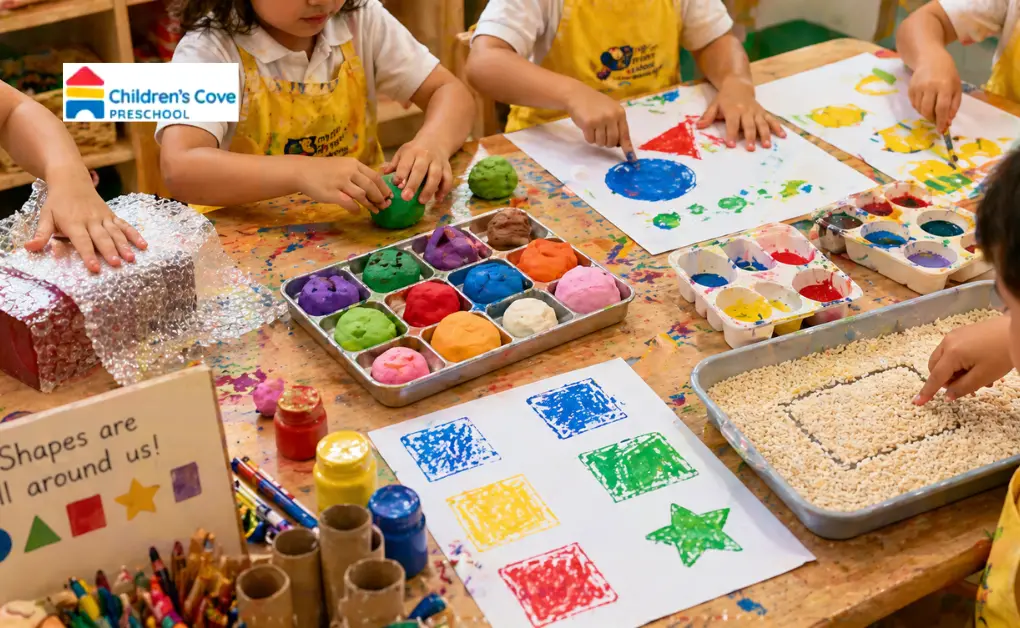
Children learn shapes faster when their hands are involved. Here are a few easy ideas to get started:
- Roll playdough into a ball or press it flat into a square
- Finger paint circles and triangles on paper
- Cut shapes from old magazines and stick them onto cardboard
- Trace shapes in a tray of rice or sand
- Sort buttons or blocks by shape into different containers
When hands are busy, minds stay focused.
Shape Games Singapore Preschoolers Actually Love
Learning shapes does not have to happen at a table. Some of the best learning happens when children are laughing, running, and playing. These games work at home, at the void deck, or even on a walk. Many parents also use creative problem-solving activities to make learning more fun and meaningful.
Shape Sorting Toys and DIY Games
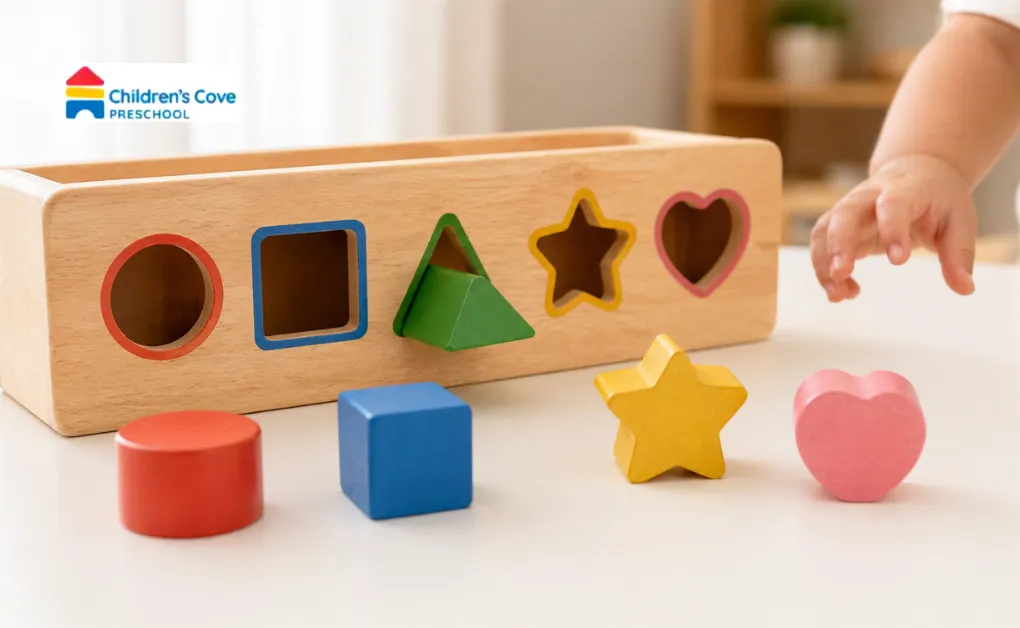
Shape sorters are one of the most tried and tested toys for young children. They are hands-on, satisfying, and keep little ones busy for longer than you might expect. You can find affordable options at Kiddy Palace or make your own at home with things you already have.
Here is how to make a simple DIY sorting game:
- Cut out different shapes from thick cardboard or coloured paper
- Label a small box or container for each shape
- Mix all the shapes together in a pile
- Ask your child to pick one up, name it, and drop it into the right box
- Once they get the hang of it, time them or add new shapes to keep it challenging
The whole thing takes five minutes to set up, and you can bring it out again and again.
Void Deck and Playground Scavenger Hunts
Step outside and turn your neighborhood into a classroom. Give your child a simple list of shapes to find on your next walk or playground visit. A circle on a drain cover. A rectangle on a letterbox. A triangle on a rooftop. A square on a floor tile.
Draw the shapes on a piece of paper and let them tick each one off as they go. Children love the feeling of completing a mission, and this one gets them moving and looking at the same time.
Body Movement and Circle Time Games
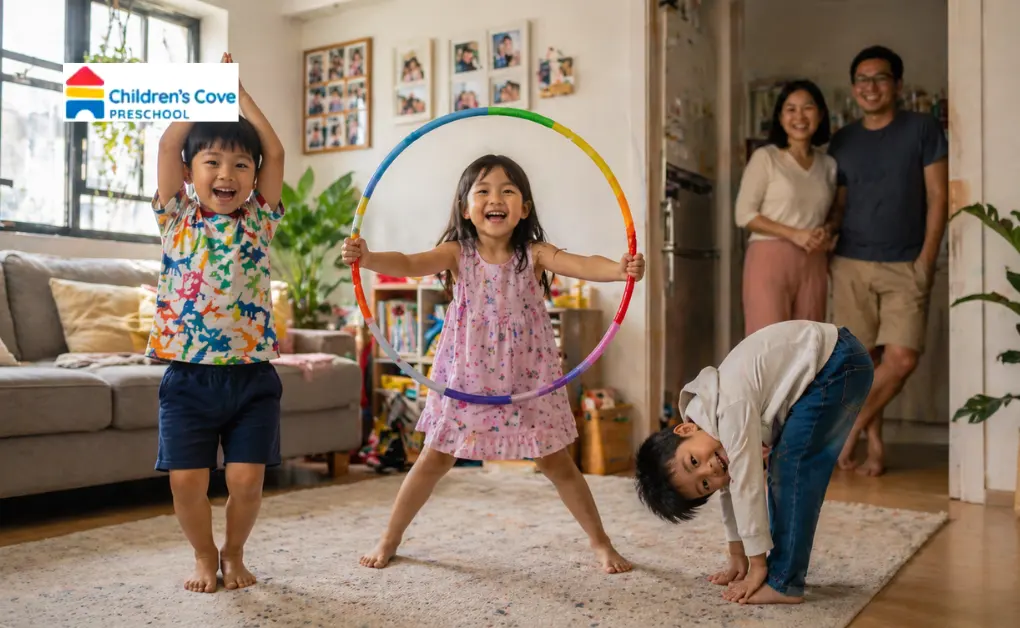
- Play Simon Says with shapes. “Simon says make a circle with your arms”
- Try shape hopscotch by drawing shapes on the ground with chalk
- Call out a shape and ask your child to find something in the room that matches
- Freeze dance with a twist. When the music stops, hold up a shape flashcard and ask them to name it
When learning feels like a game, children want to keep going.
At Children’s Cove, shape recognition is woven into everyday play and exploration rather than taught through drills or worksheets. As a trusted preschool in Singapore, we focus on making learning feel natural by building on moments children already enjoy.
The Best Books and Apps for Teaching Shapes to Toddlers
Books and apps are two of the easiest ways to bring shape learning into your child’s day without it feeling like extra work. Here are some worth trying.
Top Picture Books About Shapes
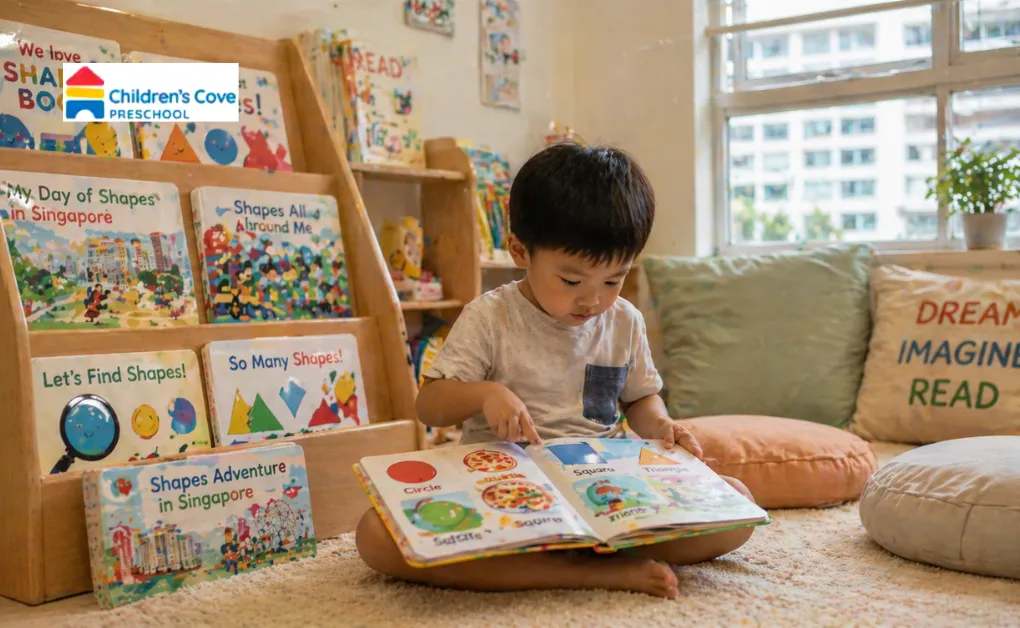
Picture books work really well for shape recognition because children can see, point, and talk about what they notice on each page. Look for books with bold illustrations, simple words, and shapes that appear in everyday scenes rather than just on plain white backgrounds.
Your local National Library Board branch is a great place to start. NLB storytime sessions also bring books to life through songs and activities, making them a fun outing for both parent and child. Best of all, they are free.
A few things to look for when picking a shape book:
- Bold, clear illustrations that make shapes easy to spot
- Simple words your child can repeat and remember
- Stories that show shapes in real places like homes, parks, and playgrounds
- Interactive elements like lift the flap or touch and feel pages
Free and Paid Apps and Assessment Books
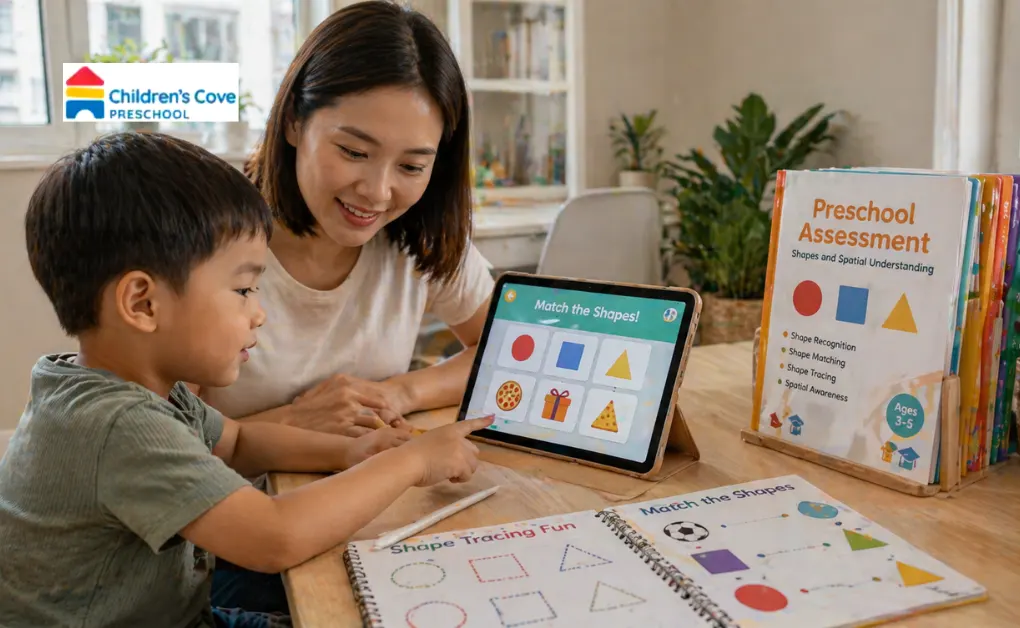
Apps can be a helpful tool when used in short bursts alongside other activities. Look for ones that are interactive, ad-free, and designed for children under five. The best ones let children tap, drag, and match shapes rather than just watch a screen.
When choosing an app, keep these in mind:
- No ads or in-app purchases that interrupt play
- Simple enough for little fingers to navigate on their own
- Focuses on one or two skills at a time rather than overwhelming with too much
- Has a parent control or timer feature so screen time stays manageable
Many Singapore parents also use assessment books as a light supplement at home. Publishers like SAP Education and Marshall Cavendish have early years titles that introduce shapes gently through colouring, tracing, and matching activities. Think of both apps and assessment books as one small tool in a bigger toolkit, not the main event.
Conclusion
Shapes are everywhere, and so are the chances to teach them. The clock on your wall, the tiles under your feet, the toast on your child’s plate. Every ordinary moment is a chance to build something that lasts, especially when you understand how preschool education supports teaching shapes to preschoolers in simple, everyday ways.
You do not need a perfect plan or a structured routine. You just need to show up, stay curious alongside your child, and make it feel like fun rather than a lesson. Some days that looks like a scavenger hunt at the void deck. Other days, it is tracing a shape on a foggy mirror or singing a silly song together.
The skills your child builds now, spotting patterns, naming what they see, and feeling confident enough to try, will follow them into the classroom and beyond. And a lot of that starts with something as simple as pointing at a window and saying, that one is a rectangle. If you are looking for a preschool in Singapore that brings this kind of joyful, curiosity-led learning to life every day, Children’s Cove could be the right fit for your child. Get in touch with us today to find out more
FAQs
1. What if my child is struggling to recognise shapes?
It is more common than you think. Most children just need more repetition and a different approach. Try movement-based activities or real-life examples instead of flashcards. If your child is significantly behind for their age or showing other developmental concerns, a quick chat with your polyclinic doctor is the easiest next step.
2. How long does it take for a child to learn shapes?
There is no fixed timeline. Some children pick up basic shapes in a few weeks, while others take a few months. What matters most is consistency. A few minutes of shape activities for preschoolers every day through play will get them there faster than occasional long sessions.
3. Should I use flashcards to teach shapes?
Flashcards can help, but they work best as one small part of a bigger mix. Children learn shapes faster when they can touch, move, and spot them in real life. Use flashcards occasionally, but do not rely on them as the main tool.
4. Is it too early to teach shapes to a two-year-old?
Not at all. Two-year-olds are ready to start with the three basics, which are circle, square, and triangle. Keep it playful and do not put any pressure on getting it right. At this age, exposure matters more than accuracy.
5. How do I keep my child interested in shapes without forcing it?
Follow their lead. If they love books, point out shapes during storytime. If they love running around, try a scavenger hunt. If they love crafts, let them make shapes with playdough. Learning sticks when it connects to something your child already enjoys.
6. Do shapes help with reading and writing later on?
Yes. Shape recognition builds the visual skills children need to tell letters apart. Many letters are made up of lines and curves that children who are comfortable with shapes find easier to recognise and eventually write.