Six months in, and your baby is a whole different little person. One day they’re just lying there, and the next, they’re sitting up, grabbing for your phone, and grinning at faces you didn’t even know were funny. It happens fast, almost too fast.
Once your baby hits this stage, just cuddling on the couch isn’t quite enough anymore. They’re curious. They’re awake for longer stretches. And with heat, humidity, and sudden afternoon showers, figuring out what to actually do with all that energy, indoors or out, can leave even the most prepared parent staring blankly at the ceiling fan.
You don’t need a packed schedule to keep your little one happy and growing. A few simple infant activities, done at your own pace, go a long way at this age.
Here are 8 easy, feel-good 6-month-old baby activities in Singapore perfect for real life, rain or shine.
8 Activities to Try With Your 6-Month-Old
1. Tummy Time That Grows Into Sitting Practice
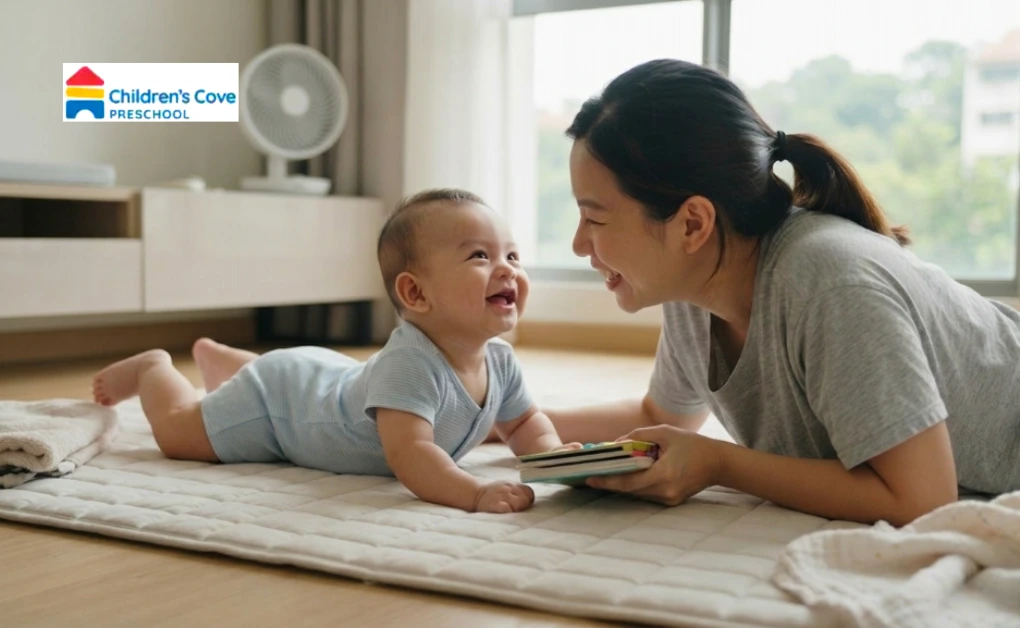
By six months, tummy time isn’t just about lifting the head anymore. Your baby is getting stronger, rolling over more easily, and building the core strength that leads to sitting up on their own. The American Academy of Paediatrics points to tummy time as one of the simplest ways to build this kind of early motor strength, small as it looks.
Here’s how to make it easy:
- Lay your baby on a soft mat, ideally near some morning light
- Keep a small fan nearby so they stay cool and comfortable
- Try it right after a bath or a feed, when your baby is calm and alert
If your baby fusses during tummy time, you’re not doing anything wrong. Stay close, talk to them, get down on the floor at their eye level. Even short bursts, done often, add up more than one long stretch ever could.
As your baby grows stronger, tummy time naturally leads into rolling, crawling, and more. Read our guide to gross motor skills activities for children; it has more ideas for what comes next.
2. Peekaboo and Other Simple Games
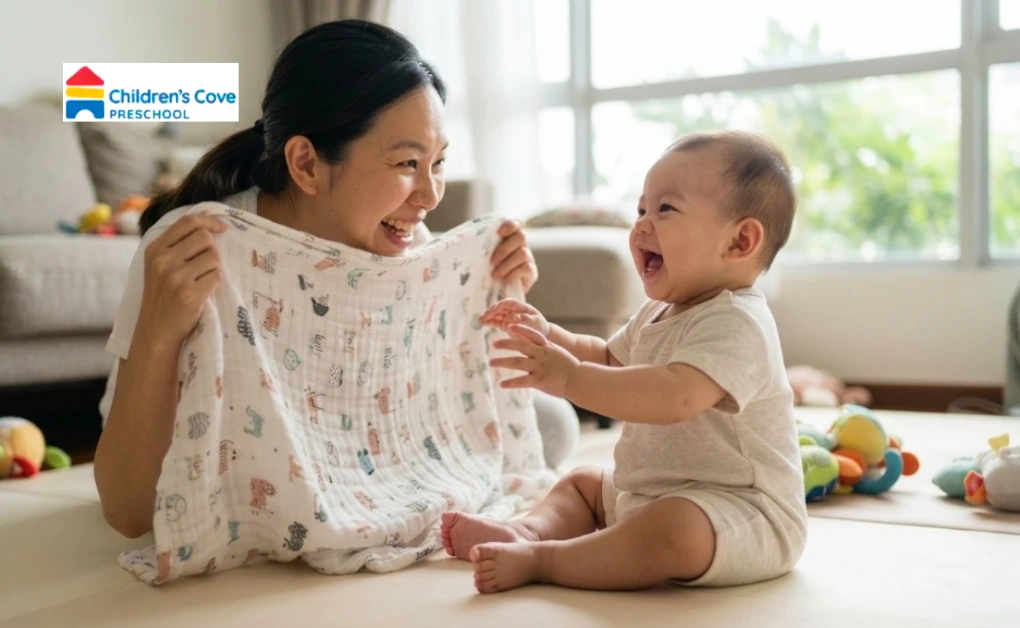
Right around six months, something clicks. Your baby starts to understand that when something disappears, it hasn’t actually gone away; it’s just hiding. This is a real developmental milestone called object permanence, and it’s exactly why peekaboo works so well at this age, and why it gets such a big reaction every single time.
Try these simple variations:
- Cover your face with your hands, then pop out with a smile
- Hide behind a blanket or a piece of furniture and peek out
- Use a favourite toy, hide it under a cloth, then let baby find it
Watch for the giggles and the wide eyes when you reappear. Your baby is remembering you were there all along, and that little bit of memory is a big step in how they’re learning to make sense of the world.
3. Sensory Play With Everyday Household Items
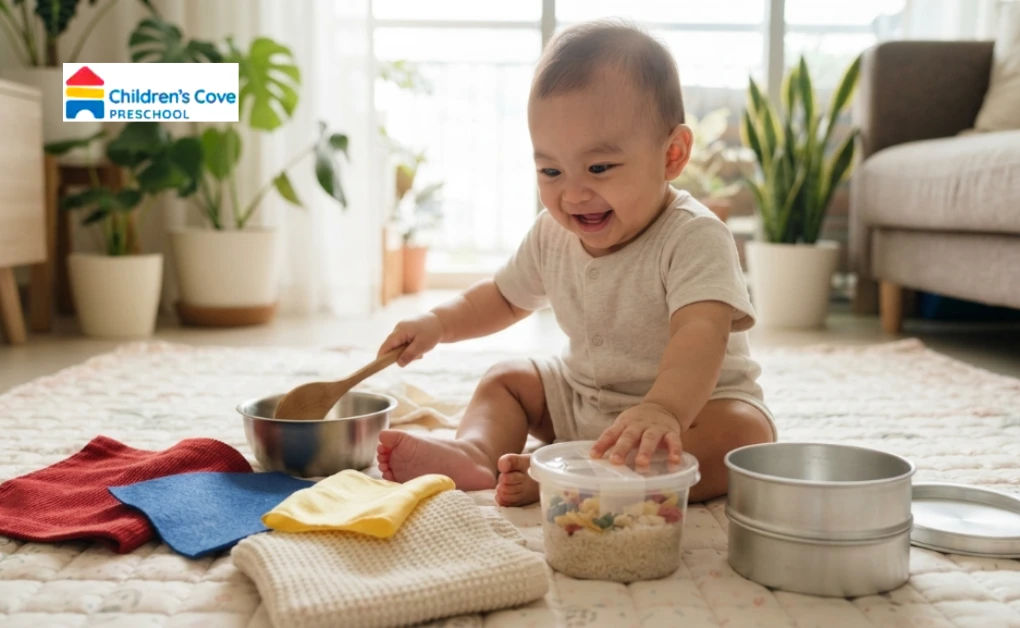
Some of the best baby sensory activities are already sitting in your kitchen or laundry basket. Touching, shaking, and chewing on different textures is exactly how babies this age take in the world, no store-bought toy required.
A few easy options to set out:
- A wooden spoon and a small metal bowl to bang together
- Fabric scraps with different textures, silky, bumpy, soft
- A container of dry rice or pasta, with the lid taped or sealed shut so it can’t come open
- A tingkat container with no clips, rings, or small removable parts, just the smooth body and lid for stacking and tapping
At this age, everything goes straight to the mouth, so stay close and check that whatever you set out has no small parts that could come loose or be swallowed. Some babies grab everything at once, others sit and study one thing for a while. Both are perfectly normal, and either way, it’s a good sign your baby is curious and paying attention to the world around them.
If sensory play is something you’d like to explore further, read our complete guide to sensory play for kids, it’s full of even more ideas as your baby grows.
4. Gentle Water Play at Home
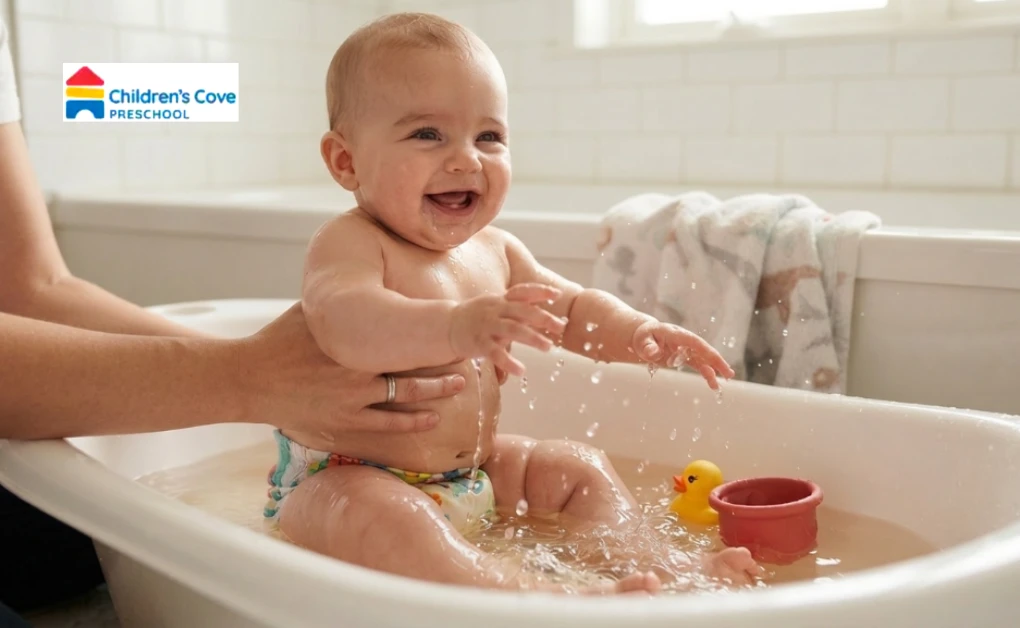
Bath time can be more than just getting clean. For a six-month-old, water is something new to feel, splash, and explore with their whole body. On a warm day, a few extra minutes in the tub often does the trick to cool your baby down and settle them for a nap.
Give these a try:
- Let your baby kick and splash with their hands and feet
- Pour small cups of water over their tummy and legs
- Use a soft, floating toy for them to reach and grab
Pediatric safety guidelines are clear on this one: always keep one hand on your baby and never look away, even for a second. Babies can slip or tip over quickly in water, no matter how shallow. With that close supervision, bath time becomes a safe little adventure your baby will start to look forward to.
5. Music and Movement Time

Babies respond to sound long before they understand words, and your voice is the one they know best. Early exposure to rhythm and singing is closely linked to language development. Singing, humming, or just talking in a sing-song way while you move together does more than it seems, it can turn a few spare minutes into a favourite part of your baby’s day.
A few ways to bring in some music:
- Hum or sing a familiar tune while gently swaying side to side
- Clap your baby’s hands together to a simple beat
- Play soft music in the background during playtime or diaper changes
Don’t worry about getting the tune right or staying on beat. Your baby isn’t judging your singing; they’re soaking up your voice, your closeness, and the joy in the moment.
6. Fresh Air at Singapore’s Parks

A change of scenery works just as well for a fussy baby as it does for a tired parent. Getting outside, even for a short walk, gives your little one something new to look at and listen to, and a little fresh air never hurts either.
If you’re wondering where to bring babies in Singapore, you don’t need anything fancy. Places like the Botanic Gardens, East Coast Park, or Jacob Ballas Children’s Garden all have wide, shaded, pram-friendly paths that make for an easy outing, even if you’re just there for twenty minutes. Your nearest neighbourhood park or HDB playground works just as well too.
Keep these in mind before heading out:
- Check the NEA weather app for the UV index and any haze advisory before you leave; Singapore’s sun and PSI levels can shift quickly
- Choose the cooler parts of the day, early morning or early evening
- Pack a hat and light layer of sun protection for baby’s skin
- Bring a small bottle of water and take breaks in the shade
A walk around your neighbourhood or a nearby park is often all it takes. Point out the trees, the birds, or a passing car, and watch how closely your baby follows along, taking it all in.
7. Rainy Day and Indoor Play Ideas
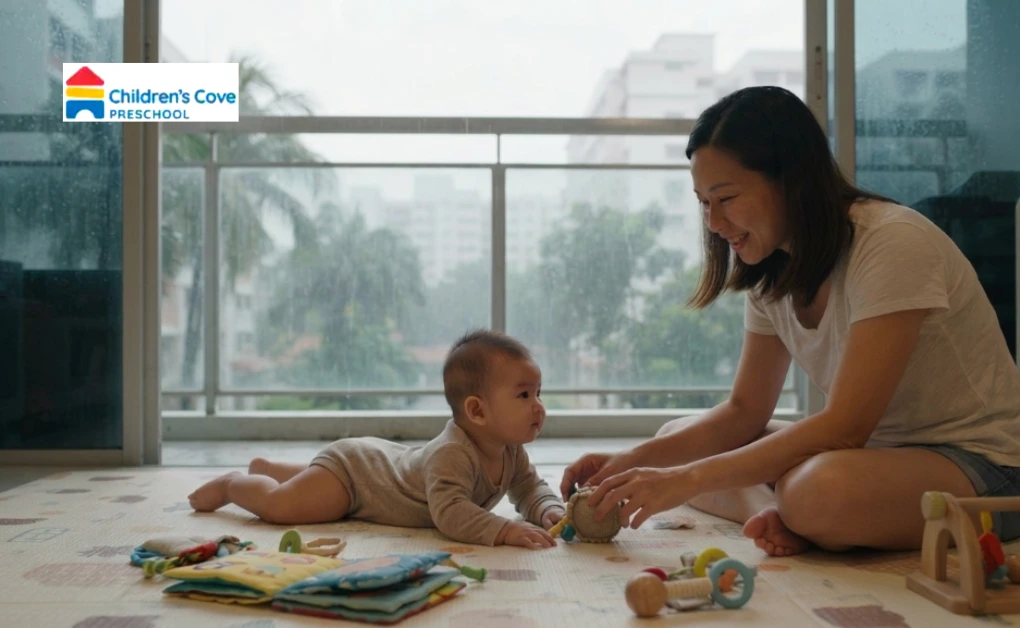
The weather sometimes can turn in minutes; one moment it’s sunny, the next it’s pouring. On days like that, you don’t need to cancel playtime altogether; you just need to bring it indoors.
Here’s what still works on a rainy day:
- Set up a small play mat in your living room and recreate tummy time or sensory play there instead
- Take a walk under the void deck of your HDB block; many are covered, breezy, and just as good for a change of scenery
- Visit an air-conditioned space like a mall atrium or library; the movement and different sounds still count as stimulation
- Keep window curtains open for natural light and let your baby watch the rain; the sound and sight of it can be surprisingly soothing
If haze rolls in along with the rain, it’s worth glancing at the PSI reading too, so you know whether to keep windows shut and the air purifier running instead.
Rainy days don’t have to mean a bored baby or a stressed-out parent. Sometimes the slower pace, blankets on the floor, soft music, an unplanned morning, ends up being exactly what you both needed anyway.
8. Reading Together (Even Before Baby “Gets It”)
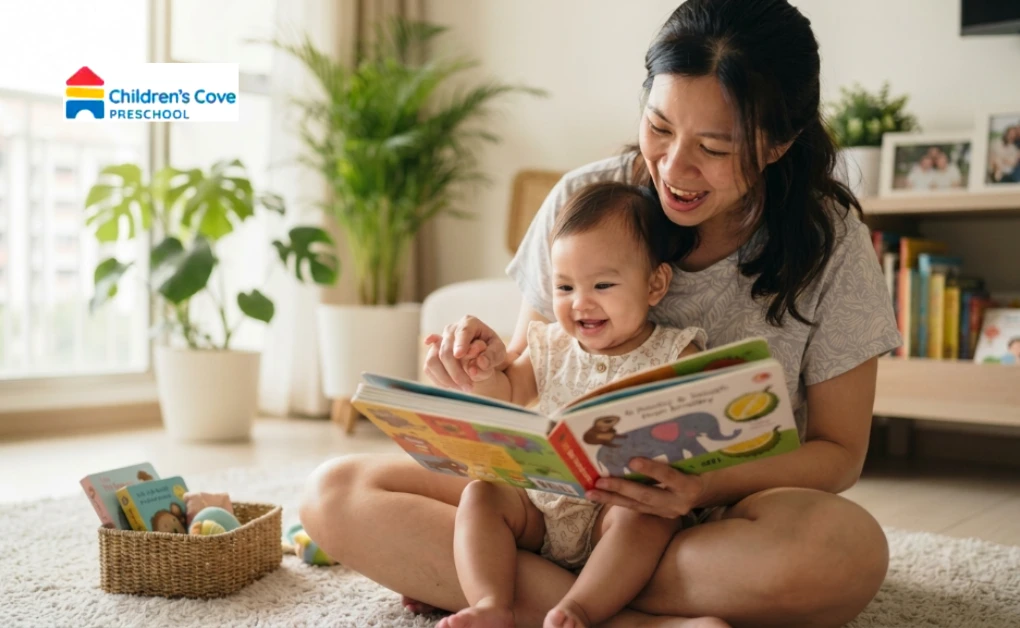
Your baby can’t follow a story yet, but that’s not really the point. Reading together at this age is about your voice, your lap, and the closeness of sitting still with someone who loves you. Even before your baby understands a single word, hearing your voice read aloud is quietly shaping how they’ll one day learn to speak. The story part comes later.
Here’s what makes reading time work at six months:
- Choose board books with thick pages and simple pictures
- Point at pictures and name what you see out loud
- Let your baby hold, chew, or flip the pages however they like
- Check out a baby reading session at your local National Library branch; many run free storytime sessions for little ones this age
Don’t worry if it only lasts two minutes before your baby loses interest or tries to eat the book. You’re not building a reader yet; you’re building a habit and a love for books that will stick around long after this stage.
How a Nurturing Infant Care Environment Supports This Stage
If you’re a working parent, or just someone who needs a little support during the day, you might wonder how much your baby is missing out on while you’re apart. Truthfully, a well-run infant care in Singapore can mirror a lot of what your baby needs at this age, not replace your role, just support it.
At Children’s Cove, our caregivers understand these milestones just as well as you do. The songs, the floor time, the gentle games we’ve talked about in this article happen naturally here too, part of each baby’s day rather than squeezed into a strict routine, whether a parent is exploring infant classes or trying to understand what is Infant care as a full-day option.
Singapore’s Early Childhood Development Agency sets a minimum caregiver-to-infant ratio of 1:5, a standard designed around how much individual attention this age truly needs. Caregivers who meet or exceed those ratios and still have time to talk, sing, and play with each baby, not just tend to their basic needs.
At the end of the day, what matters most is that your baby feels close to someone who cares. That’s what we try to give every child who walks through our doors.
Bonus Tips for Busy Parents
You don’t have to get everything right every day. Some days will feel smooth, other days will feel like a blur of naps, feeds, and diaper changes with barely a minute to spare. Both are just part of raising a baby.
Here’s what makes daily play easier:
- Pair activities with things you already do, sing during diaper changes, do tummy time right after a bath
- Rotate toys every week or two so old ones feel new and exciting again
- Use nap windows to prep the next activity, so you’re not scrambling when baby wakes up
- Keep a small basket of safe things ready for playtime, no last-minute searching
You’re not failing if you skip a day, or repeat the same three activities all week. Babies thrive on repetition and your presence far more than they need variety. Showing up, even tired, already counts for a lot.
Conclusion
Six months go by in a blink, and somehow it also feels like forever when you’re in the middle of it. Between the giggles, the fussy moments, and everything in between, it’s easy to forget just how much your baby is learning simply by being close to you.
Tummy time, peekaboo, a splash in the bath, a song, a walk outside, a book on your lap, none of these needs to be perfect or long or planned out. They just need to happen, in whatever small pockets of time your day allows.
You’re already doing the most important part just by staying close, paying attention, and loving your baby through this stage. The rest is just details.
And on the days you need a little extra support, get in touch with Children’s Cove to see what everyday care and connection looks like.
FAQs
1. What Milestones Should a 6-Month-Old Baby Be Reaching?
Babies grow at different speeds, but many are starting to sit with some support, roll both ways, babble, and reach for objects around this time. If you’re ever unsure, a quick chat with your paediatrician is always a good next step.
2. Is Infant Care Suitable for a 6-Month-Old?
Yes, many infant care centres in Singapore are set up specifically for babies from as young as 2 months old, with routines built around feeding, naps, and gentle stimulation. If you’re considering it, look for a centre with a calm environment and caregivers who genuinely engage with each baby, not just manage the day.
3. What If My Baby Hates Tummy Time?
This is more common than you’d think. Try shorter, more frequent sessions instead of one long stretch, get down on the floor at eye level with your baby, or try it right after a bath when they’re calm and alert. It usually gets easier with time.
4. Are Baby Classes in Singapore Worth It?
It really depends on your baby and your own schedule. Classes can offer structure, social exposure, and a nice change of pace for both of you, but they’re not essential at this age. Everything a class offers singing, movement, sensory play can also happen at home, just as effectively.
5. Is Screen Time Okay for a 6-Month-Old Baby?
Most health guidelines, including from the American Academy of Paediatrics, suggest holding off on screen time at this age. Babies learn best through touch, sound, and real interaction with the people around them, not through a screen. A quick video call with grandma now and then is a different story.